Years ago I saw a meme I still can't shake.
A side-by-side image of Bruce Springsteen and Göran Persson — the former Prime Minister of Sweden.
Both born the same year.
Both men of power and money.
Both 65 at the time of the photo.
One was shirtless in the ocean, looking 45.
One was pot-bellied, bespectacled, looking like he'd already retired from life.
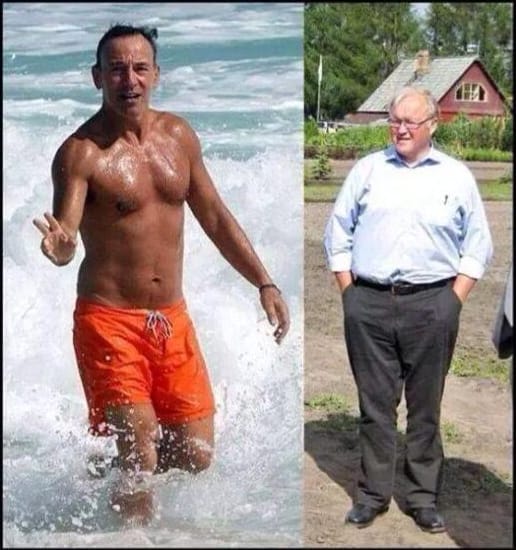
I was shocked that two successful men of the same age could look so different.
That's when I made a mental note: I want to be Springsteen when I'm older. I will never let myself become Persson.
Rich enough to afford anything. Too weak to enjoy it.
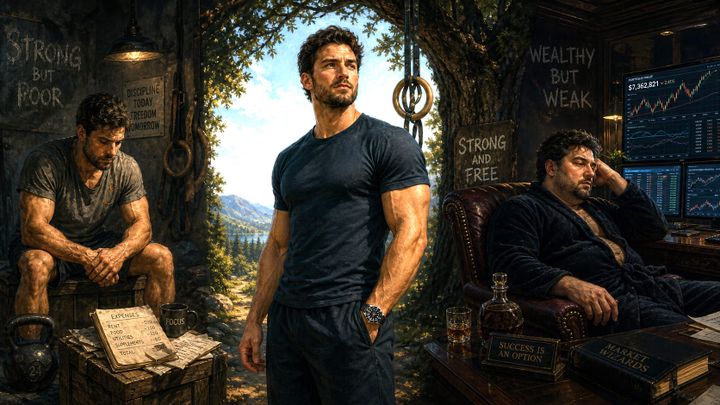
Imagine a man.
He found a consulting niche the market valued and went all in — 16-hour days for years. Eventually he got there:
He can afford any luxury.
He can travel wherever he wants.
He never has to work on anything he doesn't want to.
But he's utterly dependent on the comfortable infrastructure of modern life.
As soon as the alarm goes off, he's swallowing three painkillers, hoping he won't have to move to four. Chronic pain in his back and knees barely lets him sleep.
At the office, he curses under his breath at the flight of stairs. Every step is a sledgehammer to his knees.
At home, his kids want to play.
He tells them he's tired and he'll do it tomorrow. He's said the same thing for weeks. He parks himself on the sofa where he can finally rest his aching body.
His wealth gave him options. His body eliminated most of them.
The other side of the equation
Now imagine a jacked school janitor.
He believes food either invites disease or fights it. So he eats meat, eggs, fruit, vegetables, Greek yogurt, honey. He's up at 5am lifting weights before the job starts.
His physique is a work of art. He has energy to play with his kids in the evening.
He can clean a building spotlessly, carry equipment others can't, and outrun most men half his age.
But when the district cuts his hours without warning, he doesn't negotiate. He nods and takes a second job as an evening Uber driver. Suddenly he's working 16-hour days just to keep the lights on.
The cortisol from two jobs and a family is slowly breaking down the body he spent years building.
His strength is real. His options are not.
Why most men choose one and neglect the other
There's an odd mental division between men who value fitness and men who build wealth.
The gym crowd and the FIRE crowd almost never overlap. Each community quietly gives its members permission to neglect the other half.
I think I understand why.
Doing both simultaneously is genuinely hard. It requires a different kind of commitment than specializing in one direction.
But I refuse to choose.
Wealth means nothing without health. And health means little if you're still shackled to someone else's schedule.
They're not competing priorities. They're two sides of the same coin, and a man who has one without the other isn't free. He's just comfortable in a different kind of trap.
What both together actually looks like
Most people imagine it requires perfection. A man who's equal parts athlete and investor, running on four hours of sleep and iron discipline.
It doesn't.
Strip both down to their fundamentals and you're left with four habits — repeated over years and decades. Nothing more.
Movement. Fifty burpees every morning before the day starts — I've done this for 630+ days straight without missing a single one. It takes less time than most people spend scrolling before breakfast (7min). Three short kettlebell sessions a week is the goal I'm still building toward consistently.
I'm not perfect at it yet.
But the burpees taught me something important: when movement becomes as non-negotiable as brushing your teeth, it stops requiring willpower entirely. That's what I'm trying to replicate with the rest of my training.
Nutrition. The goal is simple: eat mostly meat, eggs, fruit, vegetables, Greek yogurt and whole food ingredients, with room for a weekly meal where I don't think about it. No app, no tracking, no complicated protocol. Just a default that's hard to break because it's simple enough to maintain.
I mess this up more than I'd like — I'm still a bit heavier than I want to be, which tells you this is a work in progress. But the direction is clear. That's enough to keep moving.
Investing. Set up an automatic transfer of 10-20% of your take-home pay into a global index fund the day after you get paid. Then forget it exists. The average annual return over the long run is around 7-8%. The compounding is invisible for years — then suddenly it isn't. The only way to fail is to stop.
And the mistake is thinking you get nothing before then.
Even a modest buffer becomes the backbone of your economic security — what allows you to quit a job you hate, travel across the world, or chase an opportunity you believe in without worrying about short-term bills.
Revenue. Keep moving yourself toward work that sits at the intersection of what you're good at, what you enjoy, and what the market pays well for. Journal about it. Have the uncomfortable conversations about money. Even inside a 9-to-5, a higher salary feeds the investing habit, and the investing habit eventually buys you options.
These four habits compound in both directions simultaneously.
Every month that passes you're slightly stronger, slightly fitter, and slightly richer than the month before.
Not as fast as I'd like, but sooner than I expected.
I went from 97 to 93kg (214 to 205lbs) and my mother noticed immediately.
I've barely started investing again, with a modest amount spread across index funds, silver and crypto. And already the low-grade financial anxiety that used to sit in the background has quieted slightly.
Not gone. Just less loud.
I can only imagine what it will feel like with ten times that in the account.
And over years and decades the gap between you and the man who chose only one becomes impossible to ignore.
Complexity is the enemy of consistency.
Whatever version of these habits you can actually maintain, start there.
Some is always better than none. You can't steer a stationary ship.
Springsteen wasn't lucky
Springsteen didn't look younger because he was genetically gifted.
He looked younger because he made a different set of daily decisions for decades.
And he's not alone.
Lenny Kravitz is in his 60s and looks like he's in his 30s.
(Here's a youtube short if you don't believe me)
Is he an outlier?
Probably. Genetics play a role nobody should pretend away.
But the disbelief people feel when they see him isn't really about his genes. It's about how low the expected standard has fallen.
Most men in their 60s don't look like Kravitz. But most men in their 60s also stopped moving seriously in their 40s, ate whatever was convenient, and called it inevitable.
The gap between Kravitz and Persson isn't entirely genetic. A significant part of it is daily decisions made over decades.
That part is available to everyone.
The same compounding that builds wealth builds the body. And the same neglect that erodes one erodes the other.
Both are practices. Neither is a destination.
Start both now. Not when you're ready. Not when one is sorted. The compounding starts the day you do.
PS. Springsteen and Persson didn't diverge overnight. It was decades of boring decisions, compounding in opposite directions. The four habits above aren't really four. They're two disciplines (one for the body, one for the money) each running on the same non-negotiable rule.
I wrote down the simplest, most reliable version of both. That gap above grows a little more every day you don't have a system.
Get it here for free: IronAndGoldStarterKit.com