
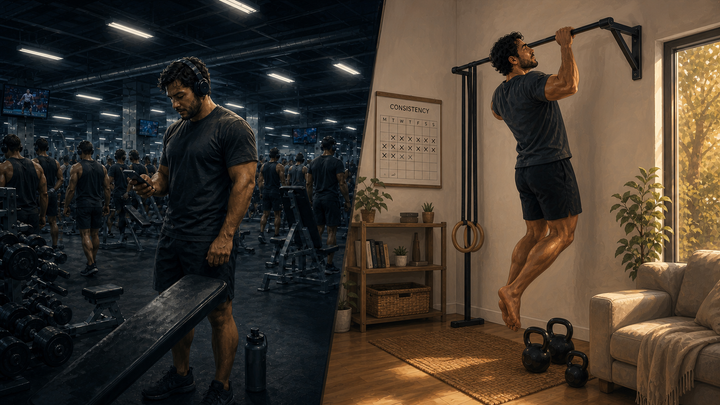
I've tried to become a "gym person" for decades.
In different cities. Different countries. Even different continents.
And every time, I found the same thing.
I was surrounded by people, but everyone had their headphones in. Instead of talking between sets, they were on their phones. At most I got the occasional nod from someone who happened to train at the same time as me.
In theory, I was surrounded by like-minded people.
In practice, I felt far more alone than I did in my own apartment.
It took me decades to understand why. And what I do instead now is cheaper, more effective, and has made me stronger than any gym ever did.
What the gym was sold as, versus what it actually is
Gym marketing sells energy, community, motivation. A tribe of like-minded people getting stronger together.
The reality? Headphones in. Eyes down. Phones out. Some filming themselves. Everyone waiting their turn and avoiding each other.
I call it being isolated together.
You're surrounded by people and connected to none of them. It's the loneliness of a crowd. And you're paying monthly for the privilege.
When was the last time the gym gave you a real conversation, and not just a nod from a stranger you'll never speak to again?
How men actually used to bond
For most of human history we lived in tribes of around 150 people, and men bonded by doing hard physical things shoulder to shoulder.
Male friendship has always been more side-by-side than face-to-face.
It's built through shared effort toward a common goal, not through talking across a table.
We get some of this as boys, through sport. The same teammates, the same field, the same struggle, week after week.
Then we become adults and lose it almost entirely.
The Swedish boy who played hockey with the same crew every winter now walks into a fluorescent-lit gym alone, earbuds in, and calls it staying active.
That's the quiet tragedy.
We didn't just stop playing. We replaced a brotherhood with a building full of strangers and told ourselves it was the same thing.
The gym stepped into that gap and pretended to fill it. But it never did.
Why the home gym is actually superior for most men
Once you accept that the gym isn't giving you a brotherhood, you see what you're actually paying for: equipment and a commute.
And once you see that, the case for training at home stops being about convenience and starts being about results.
Consistency is the whole game, and home wins it.
Nobody gets strong from their best workout. They get strong from the workouts they keep doing for years.
The single biggest variable in physical transformation isn't intensity or programming. It's how many times you actually show up, over how many years.
And almost everything that breaks consistency lives at the gym, not at home. The commute. The weather. The packed bag. The crowds at peak hours. The closed-on-holidays. The "I'll go later" that becomes "I'll go tomorrow."
At home there's no packaged bag, no commute, no waiting, no excuse. The friction is gone. And when the friction is gone, you keep going.
As I write this, I've done 654 days of daily burpees without missing one.
Through fevers. Through injuries. I just scaled the difficulty down to protect the streak.
And I could never have done that if it required leaving the house. The habit survived precisely because it asked almost nothing of me logistically.
The math nobody runs.
A gym membership runs you somewhere around $40 to $70 a month. Over a decade that's $5,000 to $8,000, plus a few hundred hours of your life spent commuting to and from a building.
A couple of kettlebells, a pull-up bar, and a set of rings costs a few hundred dollars. Once. And it lasts the rest of your life.
You're not buying a downgrade. You're buying back your time and saving thousands while you do it.
You can train more often, not less.
When the pull-up bar is in your doorway, you do a few pull-ups every time you walk under it. A set here, a set there, all day. Never tired, never sweaty.
This is called greasing the groove, and it's one of the most effective ways to build strength that exists, because strength is partly a skill, and skills improve with frequent, fresh practice.
The gym structurally prevents this. You can only train when you've made the trip. Home makes high frequency effortless.
The equipment is genuinely enough.
Here's what a few kettlebells, a pull-up bar, rings, and your own bodyweight can build: real full-body strength, serious conditioning, and skills most gym-goers never develop.
Pistol squats. Clean pull-ups and muscle-ups. Ring dips. Handstands.
Kettlebell flows that train strength, power, and cardio in one sequence.
The kind of strength, control, and visible muscle most people never expect from a man over 30.
When a movement gets too easy, you add a kettlebell or progress to a harder variation. The progression is effectively infinite.
For the vast majority of men, whose goal is to be strong, lean, capable, and healthy rather than to compete in powerlifting, the wall of machines at the commercial gym is mostly redundant. You were sold complexity you never needed.
It makes you self-sufficient.
A kettlebell fits in a corner. Wooden rings fit in a backpack. Bodyweight needs nothing at all. You become a man who can train in a hotel room, a garage, a forest, or a new country, for the rest of his life, never dependent on a facility, a membership, or a city.
I'm moving my family abroad in the coming years. My training comes with me in a suitcase. That kind of physical self-reliance is its own subtle form of freedom.
Why I built it all on burpees
My whole home setup rests on one daily anchor: the burpee.
It's a true full-body movement.
A squat, a jump, a plank, and a push-up in one fluid sequence. It trains strength, power, and endurance at the same time, with no equipment and infinite room to scale up.
There's a reason Spartan obstacle races use burpees as the punishment when you fail an obstacle. They're brutally effective, and brutally simple.
Thirty burpees every morning became the foundation. These days it's fifty. No matter what else happens, that happens. Everything else, the kettlebell flows, the pull-ups, the sport, sits on top of that base.
It's not the only thing you need.
But as a daily anchor that builds real muscle, conditioning, and grit while asking nothing of you but a patch of floor, nothing beats it.
For more size, you add the kettlebells and rings. But pound for pound of effort, nothing gives you more than the humble burpee.
The fix: split the two apart
Stop asking one building to give you both a workout and a brotherhood. It does neither well.
Get your training done at home, where you can do it at the same time, in the same place, every day, without interruption.
A thirty-minute kettlebell flow before your morning shower will do more for you over a year than a gym membership you use twice a week in theory.
Then get your brotherhood from something that actually produces it: a real sport, with real stakes and real shared struggle.
Men don't bond by talking. They bond by going through something hard together, whether shoulder to shoulder or toe to toe.
The best options that hold up across your 30s, 40s, 50s and beyond:
Veteran football for the classic team experience. Rowing or a cycling club for lifelong, joint-friendly, shoulder-to-shoulder effort. Padel or doubles tennis for something social and easy to pull busy friends into. And Brazilian Jiu-Jitsu for the deepest bond of all, where the man you struggle against on the mat becomes a brother through the struggle itself.
That's where the friendship lives. Not on the bench press next to a stranger.
What I've learned
The gym isn't evil.
For some men, with certain goals, it's genuinely the right tool, and a few of them really do find their people there.
But most men signed up for a brotherhood and got a room full of strangers.
They signed up for the most efficient path to a strong body and an iron mind, and the gym failed to deliver either.
Take your training home, where consistency is easy and the results compound for decades.
Take your need for connection somewhere it can actually be met.
You can have both a strong body and a real tribe.
But for most men, it won't come from the same place that promised both and delivered neither.
PS. Strip it to what actually moves the needle. Remove everything that doesn't. That's the whole case above for training at home instead of the gym. Same rule runs my money.
One non-negotiable habit, no recurring bleed, no membership required. 654 days in, the friction still hasn't come back. The whole system for both the money and the body, free at: IronAndGoldStarterKit.com