
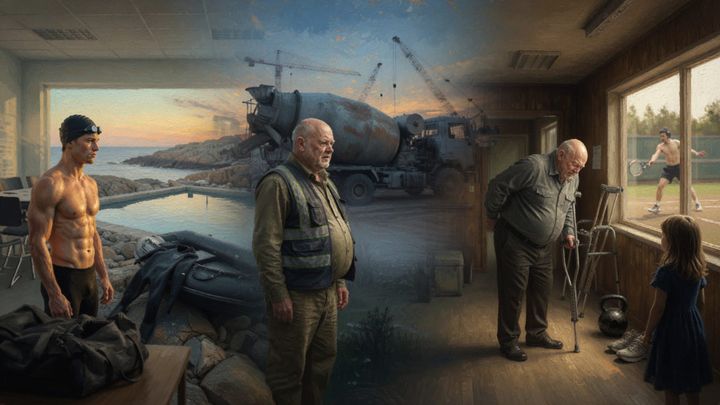
When I grew up, I looked at my father as a man who had life figured out.
He had his own company. He made good money. He had fathered three sons.
He always seemed to have a few well-chosen words of wisdom from the generation before him in his back pocket.
He was the strong, silent type. A doer more than a talker. As far as I knew, there was nothing he hadn't already figured out.
Then, in what felt like a single season, he was applying for jobs he'd once considered beneath him. Driving instructor. Cement truck driver. Worse.
The fall
My father had run the company he started with four colleagues for a long time. Years of experience. Always good money.
But running something for a long time can also make you complacent.
They had slowly grown reliant on one supplier for three quarters of their business.
Since that had been true for so long, and never once been a problem, it went unquestioned. Maybe they'd spent more energy worrying about not being reliant on any single customer than they ever spent worrying about the supplier side.
Then a boardroom decision was made in a country my father never even operated in, and the business he'd built with four colleagues couldn't survive on the one quarter that remained.
What's the one thing your entire income currently depends on?
One employer. One client. One supplier. One platform. If you can name it in a single word, you already know what my father's company didn't see coming until it was too late.
The search
My father went looking for a job.
What surprised me was how years of co-running a company could somehow read, on paper, like years of the wrong thing.
He barely got calls back.
When he finally did, it was for jobs like driving instructor. A steep fall, in money, in prestige, in almost everything.
When we talked, he told me:
"If I was just ten years younger, I would have started another company. But I just don't have it in me to try again in my fifties."
After years of his confidence approaching the floor, he was finally forced to take a job as a cement truck driver.
The cement truck years
The one mercy in it was that he'd always liked to drive.
But it meant rising before dawn every morning at an age when most men are winding down, not starting over.
He drove to building sites all over the city.
In his late fifties and early sixties, he was doing physically demanding work most men his age had long since left behind. It was the only door that had opened for him.
The colleague
One of his colleagues, a man his own age, was driving his truck to a delivery when he suffered a stroke behind the wheel.
The truck went off the road and into a ditch. He didn't survive it.
He'd been months away from retirement.
My father retired a year earlier than planned. He never fully explained why. He didn't have to.
And he's been retired sixteen years now. It hasn't been one straight road. There have been harder stretches and easier ones, like most long retirements are.
The bill comes due
My father was an athlete growing up.
A competitive swimmer, and half a dozen other sports on top of it.
He was in such good shape out of high school that he was selected to train as a Kustjägare, literally "Coast Hunter," the Swedish equivalent of the U.S. Navy SEALs.
I loved hearing his stories about that growing up.
Like most adults, he put on some weight in his forties. But he still played tennis with his colleagues every Friday, for years.
After losing his company, though, I think it took a toll on his mind that he never fully put into words. He smoked more. Drank more. Became generally more inactive, and heavier.
Carrying too much weight for years wore his knees down to bone on bone. For a while he had to walk bent forward, hands interlaced behind his back, just to ease the pain.
Years later, out searching for his runaway dog, he came home exhausted, tripped in the hallway, and broke his hip. Surgery. A wheelchair. Crutches he still relies on, years later.
Everyone can expect some health challenges in their seventies and beyond.
But I've come to notice the pattern: the men who spent years sitting down, carrying extra weight, and smoking rarely get the gentle version of aging. The men who didn't, often do.
That's not a coincidence. It's just a long line of small decisions, finally presenting the bill.
I think of my father's old tennis partners from those Friday matches. I don't know most of their stories.
But I'd bet real money that the ones still walking upright, still traveling, still getting on the floor with their grandkids, are disproportionately the ones who never fully stopped moving.
Here's what I keep coming back to, not as a verdict on him, but as a debt I owe to what he lived through.
What I learned
The gold lesson: I used to believe that running your own company was enough to be in control of your destiny.
My father's experience taught me otherwise.
You can't rely on one supplier or one client any more than you can rely on one employer.
Antifragility means spreading the risk, no matter how you make your money.
The iron lesson: a maintained body isn't vanity.
It's the difference between a retirement you can walk through and one you endure bent forward, hands behind your back, managing pain that years of neglect made almost inevitable.
My father wasn't perfect. He did the best he could with what he had.
Now it's up to me to do the same, with what I have.
Watching him taught me exactly what's at stake. I'm sure I'll be imperfect too.
But I intend to learn from what I've seen, so I don't repeat the exact same mistakes. For my own sake. And for my daughter, who will imitate what I do whether I want her to or not.
P.S. My father built a good life with the tools his generation trusted: one company, one supplier relationship, a body he assumed would simply hold up.
Nobody handed him a different playbook. I wrote the Iron & Gold Starter Kit because I wanted one for myself.
It won't rewrite the past. But it might help you build a version of the future that doesn't come down to job searching in your late 50s and a retirement with bone on bone. Get it at IronAndGoldStarterKit.com.