
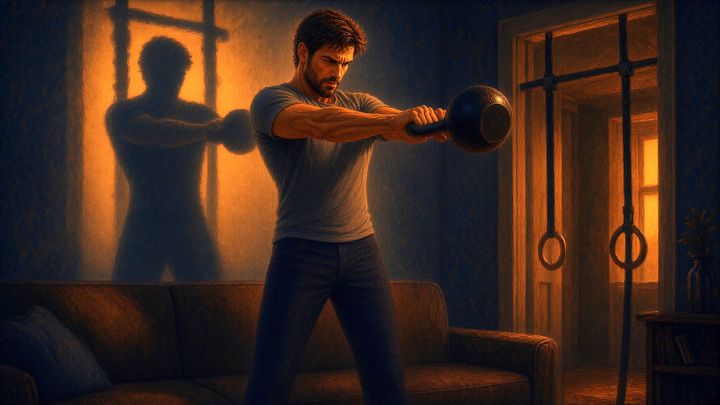
Most men think muscle requires equipment.
A membership at minimum, ideally a garage full of iron.
Most of my training happens in about 10 square meters (107 square feet).
And I'm more muscular now than I've ever been.
My mother grabbed my arm to say something a while back and stopped mid-sentence because of what was underneath the sleeve. That's a stupid thing to be pleased about at 39, and I was pleased about it anyway.
But that's the byproduct, not the aim.
What I actually train for is being able to lift my daughter without thinking about it, and being able to do the same thing with my grandchildren when I'm sixty.
The reason to train at home isn't the money.
It's that the packing and the commute is where most training dies.
The gym's real price isn't the membership
You sign up thinking you're going to get strong here. With all this equipment, how could you not?
Then the hidden costs arrive:
- Packing the bag
- Travel time
- Changing
- Waiting for equipment
- The trip home
40 minutes of training becomes 90+ minutes of your evening.
Run that across a year. Three sessions a week at ninety minutes is 234 hours. The same three sessions at home, forty minutes each, is 104.
That's 130 hours a year. More than three working weeks, spent packing bags, sitting in traffic and waiting for a bench.
And that's if you go. That inflation is exactly what makes it skippable on a bad week, and bad weeks are most weeks.
Home training removes the gap between deciding and starting. You can train in your boxers. No bag, no changing, no travel, no waiting.
Set a timer for thirty minutes and you're finished before the other version of you has parked the car.
The five things a body needs to be able to do
A gym floor makes it look like the human body moves in a hundred ways and each one needs its own machine.
It doesn't. Underneath everything there are five patterns:
- Push
- Pull
- Hinge
- Squat
- Carry
Everything else is a variation on one of those.
The gym isn't offering you more patterns. It's offering you more machines for the same five.
What you actually need
So the question isn't what equipment gets you strong. It's what covers those five in ten square meters.
One thing does most of it, and you already own it.
Your body.
The burpee is a squat, a jump, a plank and a push-up in one sequence. Strength, power and conditioning at once, with nothing to buy.
Spartan races hand them out as punishment for a failed obstacle for a reason.
I attribute most of my current physique to daily burpees across 700+ days.
But bodyweight can only ever load you with your own weight, and that ceiling arrives sooner than most men expect. Which is where the second thing comes in.
A kettlebell.
One tool covers swings, squats, presses, pulls and carries. It costs little, lasts a lifetime, and lives in the corner of a room.
What it adds is real iron and, more importantly, the posterior chain. Hips, glutes, hamstrings, back. Everything that powers a strong movement and everything that bodyweight training tends to under-serve.
It builds grip along the way, and grip is one of the truest marks of a strong man.
Don't just lift it. Flow. Move from one movement into the next without setting the bell down and strength work becomes conditioning at the same time.
Where to start: 8 kg if you're not fit, 12 kg if you're in decent shape, 16 kg if you're already strong.
Then there's the third thing, and it's the one most home setups skip.
Pulling.
This is the genuine hole in apartment training and the reason a lot of home-trained men end up with a strong front and a weak back. Burpees push. Kettlebells hinge and press. Neither of them pulls the way a body needs.
A doorway pull-up bar fixes it for the price of a takeaway.
Add wooden rings and you have rows, hangs and progressions that will outlast your ambition. Rings hang from the bar, a beam, or a ceiling hook, and they fold into a drawer.
Your body. A kettlebell. A bar with rings.
Push, pull, hinge, squat, carry. Five patterns, three purchases, ten square meters.
If you can't build a strong body with that, equipment was never the problem.
I own exactly this and the only thing I ever want more of is heavier bells, which I buy one at a time as I earn them.
The mistake is buying before you've earned it
Most men do this backwards. They decide to get strong and the first move is a purchase. A rack, a bench, adjustable dumbbells, a rower on finance.
Buying is the easy part of getting strong. It feels like progress, it can be researched for weeks, and no part of it can fail.
Instead, start with what you already own.
Do burpees every day for a month. If you're still doing them after thirty days, buy the kettlebell. If you're still swinging it after ninety, buy the bar.
Earn each piece of equipment with a streak.
The men with dust on their home gyms all bought the gym first.
A week that actually fits in a life
Most men think there's no room before work. Too little time, and I need the sleep.
But what if it only took thirty minutes before your morning shower?
Set a timer. Warm up for five. Spend the next twenty-five doing as many rounds of a kettlebell flow as you can.
Fewer than five rounds? Drop the weight. More than ten? Go heavier.
Then shower and get on with your day, already finished, having spent half an hour and travelled nowhere.
One practical note, since I know you're wondering.
Burpees are loud if you drop into them. Land soft, step back rather than jumping, use a mat. I've never had a complaint but can be worth considering if you live in an old building.
And there's a question worth sitting with here, which isn't about time at all.
How many hours did you spend last month researching training? Form videos, programme comparisons, the creatine debate, someone's split on YouTube.
Now compare that to the thirty minutes this actually takes.
Almost nobody is short of time. They're short of a version small enough that they stop negotiating with it.
What this can't do
Everything has trade-offs and I'd rather name mine.
If you want to compete in strongman or powerlifting, you need loads heavy enough to be genuinely dangerous without a spotter and a rack. Get the membership, get a coach. This isn't for you.
If the gym is where your friends are, that's a real reason and I won't argue with it.
For the rest of us, this gives more for less.
Not because it's optimal, but because it removes every excuse between the thought and the first rep.
The point was never that ten square meters beats a fully equipped gym.
It's that the version you'll actually do beats the version you meant to.
P.S. Training is one of three columns I run, and all three work the same way: strip it down until it's small enough that you stop negotiating with it.
The other two are what I eat and where my money goes. All of it is in the Iron & Gold Starter Kit, free here: IronAndGoldStarterKit.com