
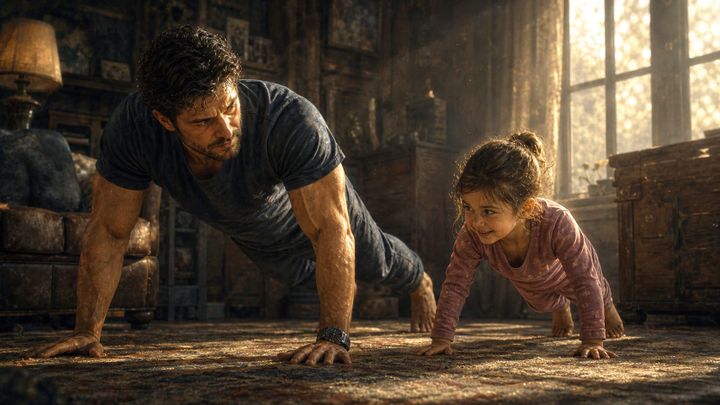
“Children have never been very good at listening to their elders, but they have never failed to imitate them.” — James Baldwin
I don't know what I expected from fatherhood other than to have a little pink mush to teach the basics.
But in the end, I feel like I was the one who was given the bigger lesson.
What I didn't expect was that fatherhood would work on me in layers.
First it was a constraint on my time. Then a demand on my readiness. Then a claim on my future. Then a clock I couldn't ignore.
If you'd asked me before she was born whether those limitations would make me better, I'd have said hell no.
But I was wrong.
Here are the five habits I built after becoming a father that have nothing to do with parenting, and everything to do with wanting to be a more capable man for my daughter.
1. The daily anchor
"I fear not the man who has practiced 10,000 kicks once, but I fear the man who has practiced one kick 10,000 times."— Bruce Lee
When my daughter was born, I'd put on a lot of weight during the pregnancy. My wife's cravings somehow became a license for me to indulge too.
I never justified it mentally. I knew there'd come a day when I had to turn it around.
But as a father with a 9-5, I didn't have much time.
Whatever I did would have to be short, effective, and possible anywhere with no equipment.
I'd read that Spartan races use burpees as punishment for a failed obstacle. A squat, a jump, a plank and a push-up in one sequence. Strength, power and conditioning at once, with no equipment.
Nothing else asks for so little and gives back so much.
That sounded exactly right.
So I did 30 burpees one day. Then again the next. And the next.
Slowly it started feeling harder NOT to do it than to do it.
Weeks went by where I didn't feel like it at all. But I couldn't bring myself to break the streak, so I continued.
After eight months it began to feel too easy, so I bumped it to 50.
As of publishing this, I've done burpees every single day for 730 days.
It's crazy.
Ten minutes a day. Thirty-odd burpees.
It sounds too small to matter.
But your body doesn't grade on ambition. It grades on repetition.
And ten months of "too small" slowly makes you unrecognizable.
I'm more muscular now than I've ever been. My mother grabbed my arm to say something a while back and stopped mid-sentence because of what was underneath my sleeve.
That's a stupid thing to be pleased about at 39, and I was pleased about it anyway.
I credit this one habit for most of it.
The truth is a busy father doesn't need a perfect program. He needs something he can do anytime, anywhere.
Some places I've done my daily burpees:
- A hotel bed in Istanbul
- A stairwell between floors
- A handicap bathroom at work
- A cabin floor on a cruise ship
- A bus station near my apartment
- A hill outside my mother's house
- A living room floor with my daughter on my back
The streak didn't survive because I'm disciplined. It survived because I stopped requiring a good place to train.
This is a habit designed for your worst day, not your best.
And that's where almost everyone gets it wrong. They set the floor at what a good day looks like: the morning you slept well, the schedule with room in it, the day nothing went sideways.
A father doesn't get that day on repeat.
Your floor isn't for the man reading this right now. It's for the you with a fever, at 11p.m, after the worst day of the quarter, with a kid who was up at two.
If it can't survive that man, it isn't a floor. It's a goal.
My 50 burpees are what I can still guarantee on a day of catastrophe. That's by design.
And beyond the physical, you build something else.
The identity of a man who doesn't break promises to himself.
That's worth even more than the body.
2. Training at home instead of the gym
I spent more than a decade trying to become a "gym person."
I'd manage for a while.
A few months of consistency, sometimes.
Then life got hectic or I got sick, and the habit collapsed into nothing.
What kills the workout isn't the workout. It's everything around it:
- Packing the bag
- Travel time
- Changing
- Waiting for equipment
- The trip home
There's no way to do a ten-minute session in your boxer shorts just to grease the groove and keep showing up on a bad day.
So you skip it. And days become weeks, which become months, sometimes years.
Removing the commute isn't a convenience upgrade. It's the difference between training and not training.
The real gym is the one you actually use. And a few pieces of equipment you use beat a room full of machines that mostly mentally tax and confuse you.
So I set a timer for thirty minutes and do as many rounds of kettlebell flows as I can.
When it rings, I step into the shower and get on with my day.
The cost was thirty minutes. What it bought was a man who's already confirmed his commitment before his daughter has woken up, and that cascades into everything after it.
A bargain if there ever was one.
Actions become habits. Habits become character. Character becomes destiny.
There's a second dividend nobody mentions, though.
Besides the friction of the gym, it also means that fitness is a place you travel to and return from which your children never sees.
But when you train at home, your kids see it as a part of how the house works.
Dad lifts things in the garage the same way as he fixes the sink.
Strength becomes a part of their home environment.
You're not teaching them about fitness as much as normalizing the idea that working out is as normal as brushing your teeth.
And most of their learning is by observation.
I can't tell you how many workouts I've done where my daughter either tries to imitate my movement patterns next to me, or jumps on top of me and becomes a spontaneous part of the workout.
3. Quitting alcohol
"No man is free who is not master of himself." — Epictetus
When you're a father, you're essentially a doctor on call.
Your child could need you urgently at any moment, and you can't afford to be the man who's incapable of responding.
A surgeon doesn't have two drinks and hope the pager stays quiet.
So while the usual argument against drinking is your liver, your sleep, your mood, the fatherhood version is simpler.
It's about being the man who can pick up the phone, get in the car, carry the kid down the stairs.
The bar isn't sobriety. It's readiness.
That was part of why I quit.
But it isn't what's kept me sober for years.
With my daily anchor and home workouts, I'm on mission to build myself into a stronger, more capable man.
And drinking? It would be like shooting myself in the foot.
How likely am I to get up and train on a Saturday morning after a night out?
Exactly.
Everyone knows alcohol impairs judgment ()that's half the appeal), but that also means the Plus-sized Big Mac menu and the strawberry milkshake at 2 a.m on the way home.
And doing that impulsively is a strong vote against the healthy, capable body you're trying to build, and ultimately your destiny.
Once you're building for something, alcohol stops looking like a treat and starts looking like a tax.
My diet has indulgence in it, because it has to be realistic. Pleasure isn't the enemy and this isn't a purity argument.
Alcohol is just poor value to me.
Everyone asks what two beers really cost in the grand scheme of things.
Not much.
But a couple of beers every Friday is just the kind of thing that can make it seem impossible to lose the excess weight you've been carrying.
And put an end to your greatness before it has even begun.
4. The automatic transfer
"The ability to do what you want, when you want, with who you want, for as long as you want to, pays the highest dividend that exists in finance." — Morgan Housel
My dad told me:
”Start saving for retirement, it’ll be here before you know it”
At 22 years old, that sounded like:
”Throw good money into a black hole and maybe, 40 years from now something comes back”
He meant well.
But to me it sounded abstract, distant, and completely unreal.
I obviously knew in my head I’d get old eventually. But I couldn’t feel it any more than I could feel myself dying or swimming on Mars.
He was describing a destination I had no interest in reaching.
So I ignored him. For 17 years.
Then years later I watched my older brother (twelve years ahead of me) do something I couldn’t stop thinking about.
He’d been consistently investing a portion of his income for years.
Then one day he just stopped working. Took a year off. Lived on his investments while the rest of us commuted.
He wasn’t rich in a Hollywood sense. He’d just started earlier and been consistent.
Same mechanics my dad had described to me close to two decades earlier. Completely different image.
That’s when it finally clicked.
“Save for retirement” = be a good boy and trust the system.
“Stack optionality” = become the kind of man who can walk away, move countries, start things, and say no to other people claiming his time or labor as their own.
Same mechanics. Completely different identity.
My dad gave me the vehicle. My brother showed me what you could do with it.
And here's what nobody mentions: even a few months of invested money is psychologically worlds apart from living paycheck to paycheck, which a huge number of men do.
The Federal Reserve found that nearly 4 in 10 Americans couldn't cover an unexpected $400 bill without borrowing or selling something. That's across all income levels, not just low earners.
That's not a retirement problem. That's a Tuesday problem.
And it's precisely the fear I'm removing from my daughter's childhood, one transfer at a time.
It took me 17 years to make a decision that took a few hours to implement.
It's the economic equivalent of the daily anchor.
Every month, the day after my salary lands, a percentage moves automatically into investments.
Small. Automatic. Gone before I notice it leaving.
The bar is so low I can't talk myself out of it. And after a few months of watching it run, I no longer wanted to.
It just feels good to get slightly richer every month instead of sliding the other way.
It isn't about what we can buy. It's about what we don't have to feel.
Financial fear taxes every decision.
It makes men take bad jobs, stay in bad situations, choose from scarcity.
The automatic transfer is the slow removal of that tax from my family's future.
5. Thinking in years and decades instead of weeks and months
"Most people overestimate what they can do in one year and underestimate what they can do in ten years." — Bill Gates
My watch measures the time of day.
But my daughter is my real physical reminder of the passing of time.
In ten years she'll be 15. A teenager.
That isn't abstract. I can picture her.
And her visual aging makes me realize how much these 10 years matters and that I can't afford to postpone my journey to become the man I can proudly see her imitate, and internalize as the standard from which all men in her life will be judged.
So that opens the question:
What are you measuring your life against?
All other habits make sense once you measure your life in the unit that actually matters.
The daily burpees aren't about fitness as much as about being alive and capable enough to always be there for her.
The automatic transfer isn't about retirement. It's about the options we have as a family while she's still a child.
Before kids, time is personal. You measure it against your own goals and you can fudge it. Five years from now is vague, because you'll just be a bit older.
After kids, time is external. She is the clock, and I can't lie to a clock that grows.
So here's the question worth sitting with.
If she copies exactly what you do for the next ten years what does she end up with? (not what you say, what you actually do)
What habits does she inherit?
And with that comes the realization that windows close with time.
The window where she wants to hold your hand in public.
The window where she asks you real questions because she thinks you know everything.
The window where your opinion outweighs her friends'.
Thinking in decades is what makes you notice and cherish the window while it's open, not after it's already gone.
It also inverts what feels expensive.
When you think in weeks, skipping a day feels costly and skipping a decade feels abstract.
Think in decades and it flips.
The missed burpee is nothing. The missed decade is catastrophic.
The month you didn't invest barely registers. The decade you didn't keeps you in chains.
Decade-thinking doesn't change the maths. It changes which number you're afraid of.
P.S. What's one habit you've started since becoming a father? Even if it has nothing to do with parenting.
P.P.S. Two of those five habits are the whole Iron & Gold system: a daily anchor for the body, an automatic transfer for the money.
Both built to survive your worst day. If you want the exact setup, it's in the Iron & Gold Starter Kit. Free at IronAndGoldStarterKit.com